
AI product data API: The Infrastructure AI commerce models and why scraping falls short

An AI product data API turns messy merchant feeds into normalized, searchable product records that teams can filter, compare, and curate in real time. It is the backbone for Infrastructure AI commerce models, the class of systems that ingest structured data, learn patterns, and then generate decision ready outputs such as the best offer, where to buy, or which products belong together in a set. Publishers using Affiliate.com query a unified dataset that spans more than 30 networks, tens of thousands of merchant programs, and over a billion products, then layer precise filters to reach the exact items their audience wants.
Scraping, by contrast, copies what a page looks like today and asks your team to reverse engineer structure from presentation. Titles change, bundling language drifts, currency formats vary, and you end up comparing almost matches. Normalized identifiers and consistent fields solve that. In Affiliate.com, identical products are grouped across merchants using barcode and other structured IDs so you compare the same SKU rather than close cousins.
Why scraping falls short for advanced affiliate programs
Scraping is brittle and siloed. It captures strings, not truth. Small copy updates break parsers. Promotions and bundles masquerade as the same product. Cross currency comparisons become guesswork. With a product data API, you search on durable fields such as brand, barcode, MPN, currency, final price, discount, availability, merchant name, merchant ID, network name, and network ID. More than 30 fields are indexed for search so teams can normalize, deduplicate, and compare with confidence.
What we mean by Infrastructure AI commerce
Infrastructure AI commerce models do not invent offers. They learn from normalized product records and apply rules or models to rank, cluster, and recommend. The inputs are stable identifiers and structured attributes. The outputs are shareable queries or Comparison Sets that your editors and apps can drop into pages and tools. Affiliate.com supports both, including a Query Builder that lets you share a link to a saved query for collaboration and execution.
The capabilities that make APIs win
- Normalization and matching: Group identical products across merchants using barcode and other IDs. This eliminates title drift and copy noise.
- Layered filtering: Combine brand, merchant, price, discount, currency, and stock to pinpoint products, not piles of results.
- Cross currency integrity: Treat one product globally while preserving local pricing so comparisons remain honest.
- Deduplication controls: Turn deduplication on for clean lists or off to expose every merchant offer in a comparison. Control is the point.
- Discovery at scale: Search across more than 30 networks and over a billion products by brand, merchant, or attributes, then refresh content as data updates.
A mini workflow that proves the difference
Goal: Publish a price comparison for a specific water bottle and keep it current.
- Anchor on identity: Query by barcode to find the exact product across merchants. This ensures you are comparing the same item, not similar listings.
- Expose the market: Turn deduplication off to retrieve all offers for that barcode, then sort by final price or discount.
- Filter for quality: Layer availability equals in stock and currency equals USD to remove dead links and mixed currency noise.
- Ship the artifact: Save the selection as a Comparison Set and share the query link with editors so they can reuse the exact logic in future roundups.
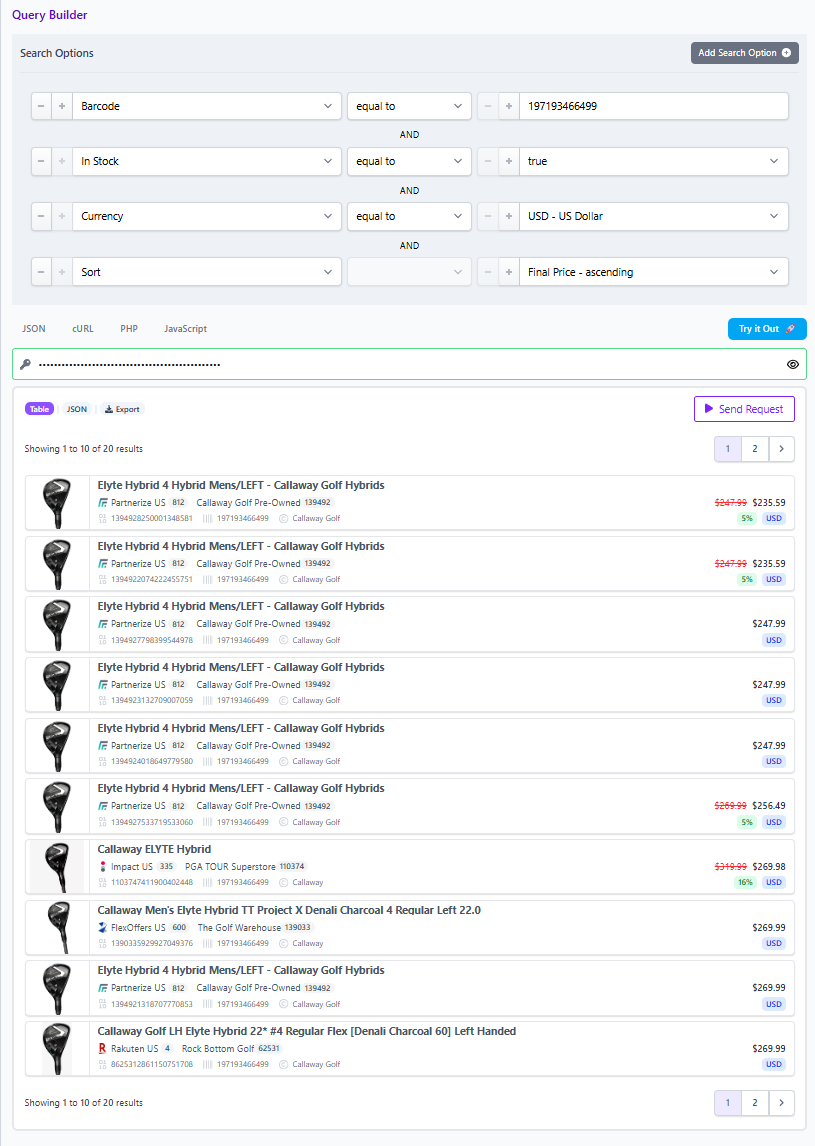
Result: A single product block with multiple merchant offers beneath it, ranked by the metric that matters for your audience, and powered by stable identifiers rather than scraped page text.
Two more applied patterns for teams
Discount only deal feed: Start with on sale equals true, add discount greater than 30 percent, keep availability equals in stock. Sort by highest discount to spotlight real savings.
Brand anchored curation with merchant governance: Filter brand equals Nike. Layer merchant ID for partners you are approved on. Add price less than sixty and availability equals in stock to ship a lean, trusted set.
Decision checklist for build versus scrape
- Do you have consistent identifiers across merchants, especially barcode and MPN, to match identical products confident.
- Can editors and analysts share and reuse query logic without rewriting code each time.
- Will you need to compare offers across currencies or show multiple merchant options for a single product on demand.
- Do you control deduplication to serve either clean lists or price comparison experiences as the context requires.
Close and next step
Infrastructure AI commerce works when your foundation is normalized data, not scraped HTML. If you want to normalize, deduplicate, barcode match, layer filters, and compare across merchants and currencies at scale, start in the Query Builder and save a shareable query or spin up a Comparison Set for your next campaign.
Verify prices and stock in the live UI before publishing. Data refreshes over time, and the best practice is to confirm final price, discount, and availability at the moment you go live.