
Finding the Right Merchant Mix with Structured Product Search for Cleaner Product Discovery

Merchant mix is the set of retailers and networks you choose to surface in a buying guide, deals page, shopping module, or internal research workflow. For advanced affiliate teams, that mix shapes far more than catalog breadth. It affects trust, offer quality, content freshness, and whether users see a market view or a narrow slice of it.
The challenge is that product discovery gets messy fast. The same item can appear under different titles, across different merchants, in different currencies, with different stock states and discount levels. Structured product search matters because it lets teams normalize those variations, barcode match where possible, deduplicate when useful, and filter with intent instead of guesswork. Affiliate.com’s product data spans more than 30 networks, tens of thousands of merchant programs, and over a billion products, which makes merchant selection a strategic exercise, not a manual one.
Why merchant mix is really a discovery problem
Most teams treat merchant mix as a partnership list. In practice, it is a discovery design choice.
A narrow mix can make a page feel clean, but it may hide better prices, stronger availability, or niche merchants that carry the exact item your reader wants. A bloated mix can create noise, duplicate listings, and a shopping experience that feels random.
Structured product search gives you a middle path. You can search broadly, then narrow deliberately using merchant, network, price, discount, stock, and product identifiers such as barcode, SKU, MPN, and ASIN. That turns merchant mix from a static roster into a controlled editorial input.
What normalization changes
Normalization means related product records are made comparable across merchants and networks, even when raw feed data is inconsistent. That matters because merchant titles are rarely written the same way.
One merchant may list a product with the full brand and model. Another may shorten the title. A third may pack the title with promotional copy. If you rely on name alone, your merchant mix will be biased toward whoever labels products most clearly.
With normalized fields and identifiers, you can do three things that materially improve discovery:
- match identical products across merchants, even when titles differ
- compare final price, discount, currency, and availability on the same footing
- decide when to deduplicate identical offers and when to keep them separate for comparison use cases
A practical framework for choosing the right merchant mix
1. Start with the user intent, not the merchant list
For a broad buying guide, variety usually matters. For a high intent product page, precision matters more.
If you are building a guide to carry on luggage, start broad with the any field or name field, then layer brand, price range, stock, and merchant filters. If you are building a page for one exact espresso machine, start with barcode or MPN so the merchant mix is anchored to the same product, not a cloud of lookalikes.
2. Use identifiers to control quality
Identifiers are your quality control layer. Barcode is strongest when the goal is exact matching across merchants. MPN and SKU help when you know the model but want to stay within a narrower manufacturer or merchant context. ASIN can be a useful starting point when tracing Amazon products to alternative merchants through barcode or other linked identifiers.
This is where teams often save themselves hours. A marketer thinks they are reviewing five offers for the same product. In reality, two are bundles, one is an older model, and one is a merchant specific variant. Good identifier use prevents that mistake before it reaches the page.
3. Layer filters to shape the mix
Once the product set is clean, shape the merchant mix with layered filters:
- Merchant Name or Merchant ID when you want known partners
- Network Name or Network ID when approval status or program scope matters
- Final Price and Sale Discount when value is the primary lens
- Availability, In Stock, or Stock Quantity when usability matters more than raw breadth
- Currency when you need a region specific view
- Brand, category, color, size, or material when the page is meant to feel curated rather than exhaustive
This is where cleaner discovery happens. You are not just pulling products. You are designing a market view that matches the user journey.
When to widen the mix, and when to narrow it
Widen the merchant mix when your goal is discovery, comparison, or uncovering lesser known offers. This is especially useful for category pages, gift guides, and editorial formats where breadth creates value.
Narrow the merchant mix when the page needs consistency. A product detail page, a price comparison widget, or a region specific landing page often performs better when the set is tightly filtered by currency, stock, and merchant eligibility.
Deduplication matters here. Turn it on when repetition harms the experience and you want one representative product record. Turn it off when the point is to show multiple offers for the same item side by side. The right setting depends on the page, not the data alone.
Applied example: building a cleaner merchant mix for a deals page
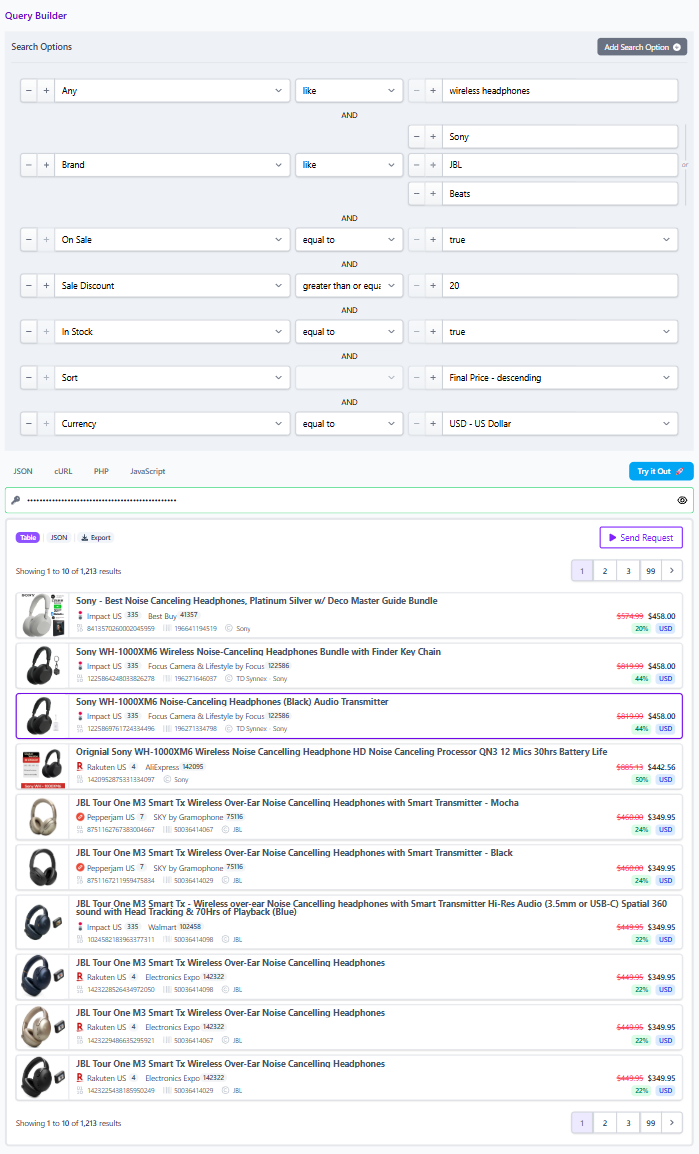
Imagine a team building a back to school deals page for wireless headphones.
Start with a broad query using the any field for wireless headphones. Layer Brand for Sony, JBL, and Beats. Add On Sale equals true, then Sale Discount greater than or equal to 20 percent. Add In Stock equals true. Add in currency filters. Finally, sort by Final Price or discount depending on whether the editorial goal is affordability or promotional depth.
At this point, inspect the results. If one product appears multiple times under different merchant titles, use barcode to confirm exact matches. Then decide whether to deduplicate. If the page is a roundup, deduplication may keep it readable. If the page is meant to compare offers, keep multiple merchants visible and use Merchant Name, Final Price, Currency, and Availability to decide which offers earn placement.
That is merchant mix done well. Not a random assortment of partners, but a reasoned set shaped by user intent, normalized data, and clear editorial criteria.
Cleaner discovery is a competitive advantage
The strongest commerce teams do not just ask which merchants they have. They ask which merchant mix produces the clearest, most useful decision environment for the user.
That is why structured product search matters. It turns merchant selection into a repeatable workflow grounded in identifiers, filters, and normalized fields instead of feed quirks and manual cleanup. For teams already working with Affiliate.com, the next step is simple: build the query in the Query Builder, test a few merchant mix scenarios, share the query link internally, and turn the best one into a reusable Comparison Set or editorial workflow.