
From Product List to Decision System: Structuring Merchant and Offer Selection Using Indexed Fields

Most affiliate teams start with a product list and end with a promotion decision. The gap between those two steps is where performance is won or lost. A product list is static, often inconsistent, and shaped by how merchants structure their feeds. A decision system, by contrast, is a repeatable method for selecting which product, which merchant, and which offer to surface.
Structuring merchant and offer selection using indexed fields means turning raw product data into a set of rules. These rules rely on normalized identifiers, pricing fields, availability signals, and merchant level context to produce consistent outcomes. Instead of manually scanning options, you define how the system should evaluate them.
Why Indexed Fields Change the Decision Model
Affiliate.com aggregates normalized product data across more than 30 networks, tens of thousands of merchants, and over a billion products. That scale only becomes useful when you rely on structured fields rather than titles or descriptions.
Three shifts matter:
- From titles to identifiers: Product names vary wildly. Barcode or MPN creates a stable anchor for matching identical products.
- From browsing to filtering: Instead of scanning lists, you layer filters like price, discount, and availability.
- From one merchant to market view: Merchant and network fields expose the full set of options for a single product.
The result is a system where decisions are derived, not guessed.
Core Fields That Power Merchant and Offer Selection
A decision system is only as strong as the fields it uses. In practice, four groups drive most outcomes.
1. Identifier Fields: Establish What Is the Same Product
Use barcode to normalize product identity across merchants.
- Barcode match ensures you are comparing the exact same SKU
- MPN helps when barcode coverage is incomplete
- ASIN can be mapped to barcode to expand beyond a single ecosystem
Without this step, every downstream decision risks comparing lookalikes instead of identical products.
2. Pricing Fields: Define What “Best Offer” Means
Price is not a single field. It is a relationship.
- Final price reflects what a user pays now
- Regular price provides context for discount calculation
- Sale discount quantifies relative value
A simple rule might prioritize lowest final price. A more nuanced system might require a minimum discount threshold to qualify as a featured offer.
3. Availability Fields: Prevent Dead Ends
Availability is often overlooked until it breaks the experience.
- In stock ensures the product can be purchased
- Stock quantity can be used to avoid low inventory listings
- Availability flags help filter out unavailable offers early
A decision system should never surface an offer that cannot convert.
4. Merchant and Network Fields: Control Source Quality
Not all merchants are equal for every use case.
- Merchant ID and name allow inclusion or exclusion lists
- Network ID ensures alignment with approved partnerships
- Commissionable status confirms eligibility
These fields let you align product selection with operational constraints, not just product relevance.
A Practical Workflow: From Product to Structured Decision
Consider a team building a high intent comparison module for a specific product.
Step 1: Start with a stable identifier
- Input a barcode or MPN to retrieve all matching listings across merchants
Step 2: Expand across the full dataset
- Query across all supported networks to avoid partial visibility
Step 3: Apply availability filters
- In stock equals true
Step 4: Layer pricing logic
- Sort by final price ascending
- Filter for sale discount greater than a defined threshold if the goal is deal driven content
Step 5: Constrain by merchant strategy
- Include only approved merchants or preferred partners
- Optionally exclude merchants with inconsistent inventory patterns
Step 6: Choose the output structure
- Deduplicate on to show one product with multiple offers
- Deduplicate off to show each merchant listing independently for deeper comparison
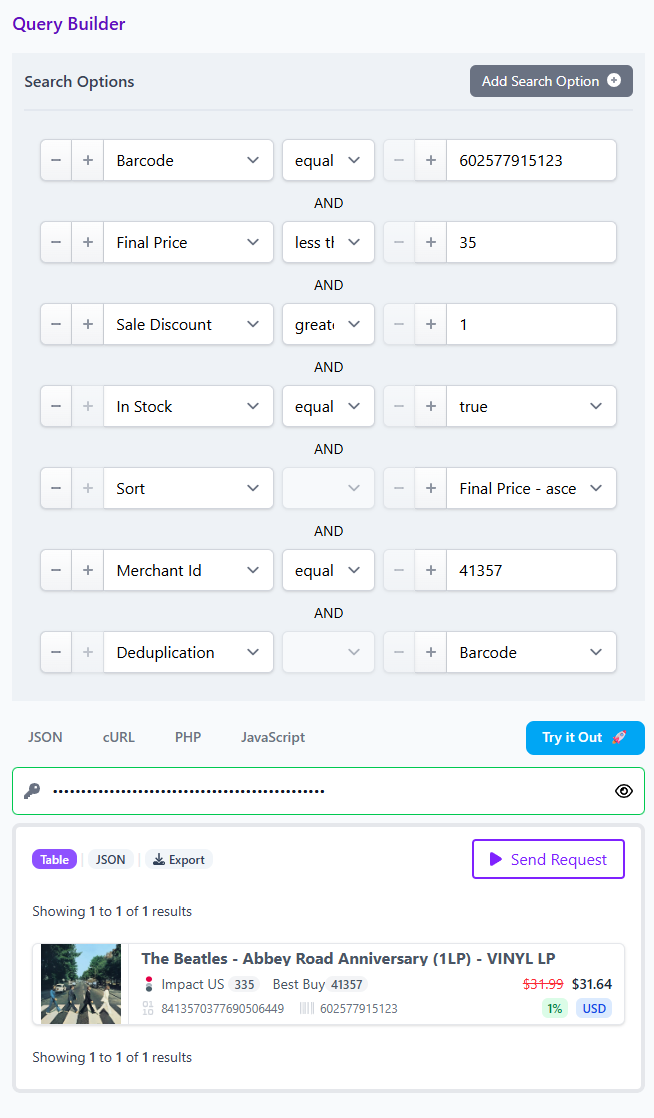
This workflow turns a single product query into a ranked, decision ready set of offers.
Deduplication Is a Strategic Lever, Not a Toggle
Deduplication is often treated as a UI choice. It is more fundamental than that.
- Deduplication on: best for editorial lists and clean discovery. One product, multiple offers beneath it.
- Deduplication off: best for comparison environments where each merchant offer is evaluated independently.
The choice changes how users perceive value. A clean list emphasizes product selection. A multi listing view emphasizes price competition.
Building Decision Criteria, Not Just Queries
The difference between a query and a decision system is persistence. A query answers a question once. A decision system answers it the same way every time.
Strong systems define:
- Inclusion rules: which products and merchants qualify
- Ranking logic: how offers are ordered, typically by price or discount
- Fallback conditions: what happens when a preferred merchant is out of stock
- Output format: deduplicated or multi listing
For example, a fallback might automatically select the next lowest priced in stock merchant if the top option becomes unavailable. This removes manual intervention.
Micro Example: Replacing a Broken Offer
A common scenario illustrates the value.
A publisher features a product tied to a single merchant. That merchant goes out of stock. Without a system, the page degrades.
With a structured approach:
- The product is anchored by barcode
- Availability filters remove the out of stock listing
- The system re ranks remaining merchants by final price
- The next valid offer is surfaced automatically
No manual update required. The decision logic handles it.
From Exploration to Systemization with the Query Builder
The fastest way to operationalize this approach is to move from ad hoc searches to saved, shareable queries.
Using the Query Builder or API:
- Start with the any field for broad discovery when inputs are unclear
- Transition to precise fields like barcode, brand, or merchant as intent sharpens
- Layer filters and sorting until the output matches your decision criteria
- Save and share the query as a reusable asset or Comparison Set
This is where teams move from experimentation to infrastructure.
Closing Thought
Affiliate performance does not come from having more products. It comes from making better decisions about which products and offers to show. Indexed fields, when used deliberately, give you the raw materials to build that system.
The shift is subtle but decisive. You are no longer curating lists. You are defining rules that scale across more than a billion products.
To put this into practice, start with a single product, build a rule set around it using barcode, price, availability, and merchant filters, and then generalize that logic. That is how a product list becomes a decision system.