
Identifier governance for AI catalogs: When to use barcode versus MPN versus ASIN

AI catalogs win or lose on identifier integrity. The job is to normalize products so models and ranking logic see one canonical item, not five near duplicates. In practice, you will juggle barcodes such as GTIN or UPC, manufacturer part numbers, and Amazon ASINs inside an ecommerce api workflow. Your governance plan should decide which identifier leads, how to fall back, and how to keep comparisons consistent across merchants and currencies.
Identifiers are not abstract. They decide whether your price impression counts are accurate, whether availability rules work, and whether experiments on discount strategy converge. This piece gives a practical framework that you can apply in Affiliate.com using indexed fields, network and merchant filters, layered search, and Comparison Sets.
Why identifiers matter
A barcode is a global trade identifier that travels with the product across merchants and networks, defined by GS1 standards. MPN is the manufacturer part number, often precise but not globally unique. ASIN is Amazon specific and useful for coverage, not universal scope. When you barcode match first, you get stronger normalization, better deduplication, and cleaner cross currency comparisons.
Affiliate.com aggregates normalized product data from more than 30 networks and tens of thousands of merchant programs, spanning over a billion products. Within the catalog, you can search or filter by brand, barcode, MPN, ASIN, merchant and network IDs, regular and final price, discount, currency, availability, and more. That breadth makes identifier governance an operational choice, not a theoretical one.
Decision framework: choose the lead identifier
Use this order of operations in most catalogs.
- Prefer barcode for canonicalization. Treat GTIN or UPC as the primary key when present. It is global and least subjective. See GS1 for definitions and format ranges.
- Fall back to MPN with brand and model. Require Brand plus MPN to reduce collisions across regions or bundles.
- Use ASIN for enrichment and coverage checks. Map ASIN to barcode when possible, then return to the barcode led universe.
- Deduplicate only after a lead identifier is established. Then layer filters for currency, availability, and category.
Mini workflow 1: barcode led normalization in the ecommerce api
Goal: produce a Comparison Set of identical items across merchants, ready for price integrity checks.
- Start with Any to seed the category. Example: Any equals wireless earbuds.
- Layer Brand equals Bose, then Barcode exists true.
- Switch on Deduplication to collapse barcode variants.
- Add In Stock equals true, Currency equals USD, and set Sort to Final Price ascending.
- Save as a shareable query link, then export a Comparison Set for repeated analysis.
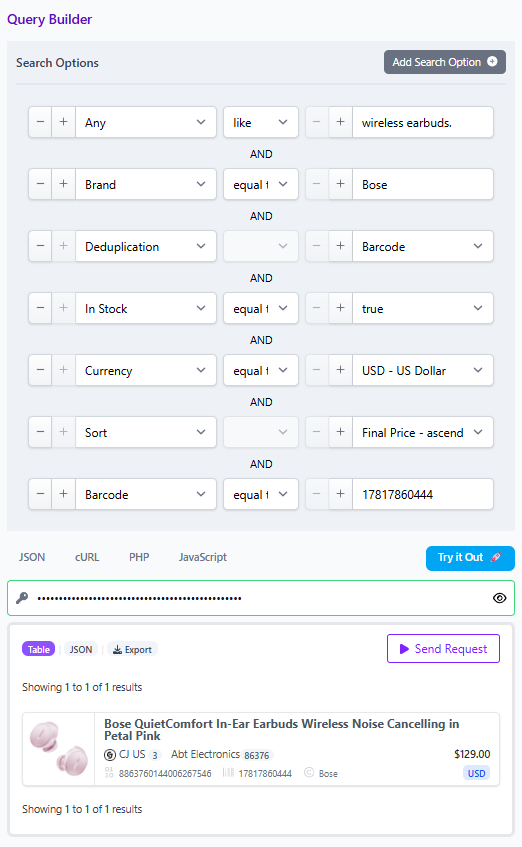
What this does: it standardizes on barcode, trims noise with network and merchant filters if needed, and prepares a clean cross merchant view for price and discount comparisons. If your team works in mixed markets, repeat the same query with Currency equals EUR to keep comparisons consistent.
Mini workflow 2: MPN governed fallback for precision categories
Some high intent categories lack universal barcodes, or merchants omit them. Use MPN with guardrails.
- Filter Brand equals ExampleBrand, MPN equals AB1234, and Barcode missing true.
- Require Name contains model keyword plus an Attribute like Color equals Black to reduce bundle collisions.
- Apply Deduplication and inspect Image URL to verify variants.
- Save as a shareable query link so ops can rerun the exact filter set.
This keeps the catalog deterministic when barcode integers are missing or inconsistent. The combination of Brand, MPN, and one or two attributes narrows false joins without overfitting.
Mini workflow 3: map ASIN to barcode, then re enter the canonical flow
ASIN can be valuable for coverage checks and partner parity.
- Search ASIN equals B0ABCD1234.
- Use the ASIN to barcode match feature to retrieve mapped GTIN or UPC.
- Re run your barcode led query with that barcode to compare across merchants outside Amazon.
- Add Network filters if you want to isolate price strategies by affiliate network.
This lets AI ranking models compare apples to apples, not ASIN walls to barcode islands.
Cross currency and price integrity
Identifier governance is a prerequisite for price integrity. Once you have a barcode led Comparison Set, you can run cross currency comparisons by adding Currency filters and converting at reporting time. Because the same barcode anchors every row, you avoid mixing bundles or generations. Remember to qualify prices as at time of writing and verify in the live UI, since merchants update feeds on different cadences.
Governance checklist for data and ops teams
- Define the lead identifier per category, barcode first when present.
- Document fallbacks, MPN with required Brand plus one attribute.
- Establish an ASIN mapping rule, map then return to barcode.
- Standardize layered filters, availability, discount, price fields, currency.
- Enable deduplication only after the lead identifier is selected.
- Store shareable query links and keep Comparison Sets under version control.
- Monitor drift, rising share of MPN fallbacks or unexpected growth in Barcode missing.
What a high trust AI product catalog looks like
A high trust catalog shows most items resolved to barcode, a small but stable slice governed by MPN plus attributes, and ASIN used as a bridge, not a silo. Deduplication reduces near duplicates without collapsing genuine variants. Network and merchant filters give clean subsets for experiments. Reproducible queries and Comparison Sets let product and research teams rerun analyses without manual steps.
Common failure modes
- Letting Any plus Name drive joins. Titles vary, attributes drift, results will fragment.
- Treating ASIN as a universal key. It is powerful for Amazon scope, not enough for cross merchant normalization.
- Deduplicating before identifiers are normalized, which collapses adjacent but different products.
- Mixing currencies inside a single price ranking experiment without a barcode anchor.