
AI product briefs: Turning an LLM Prompt into a Publishable Product Set with Barcodes, Filters, and Deduplication

An AI product brief is a structured spec that turns editorial intent into a queryable product set. The LLM is useful for drafting the brief, extracting constraints, and proposing categories, but it is not a reliable judge of product identity or offer correctness.
Affiliate.com is built for the parts that must be deterministic: normalized product data across more than 30 networks, 20,000 merchant programs, and over a billion products, with indexed fields you can filter and sort against. The winning workflow is simple, the LLM proposes, Affiliate.com verifies and constrains, and humans approve with a shareable query receipt.
Why LLM generated briefs fail in production
LLMs tend to over trust product names, and names are messy across merchants. Affiliate.com explicitly notes that titles vary and that it is not always clear when two listings are actually the same product.
They also blur lookalikes into equivalence. Bundles, private label versions, and near identical model updates often require a different MPN or GTIN, even when the words look similar.
The fix is to treat the LLM output as a draft, then force it through an identity and governance pipeline.
The identity ladder: what to trust, in order
Barcode first for cross merchant equivalence
Barcodes (UPC, EAN, GTIN, ISBN) can verify that two listings from different networks refer to the same product, which is exactly what you need for comparisons and best offer selection. Affiliate.com gives a concrete example where a single barcode query returns the exact same item across multiple merchants.
MPN or SKU for merchant scoped precision
If you are validating one merchant listing, or you are troubleshooting a mismatch, SKU or MPN is the right tool. Affiliate.com describes these as precise identifiers for a specific product from a specific merchant.
Brand and attributes for narrowing, not identity
Brand normalization is excellent for narrowing and curation, and it can be layered with other filters. Just do not treat brand plus name similarity as proof of identical products.
A production workflow: from LLM prompt to publishable set
Step 1: Prompt the LLM to output constraints, not products
Have the LLM produce a brief in a structured form:
- audience and intent (deal, guide, comparison, replacement part)
- inclusion rules (brand, category, material, model, size)
- exclusion rules (bundles, refurbished, used)
- business rules (currency, in stock requirement, minimum discount)
- governance rules (allowed merchants, allowed networks)
This keeps the LLM in its strength zone, translation and planning, without letting it declare identity.
Step 2: Discover with the any field, then narrow
Affiliate.com’s any field searches across names, descriptions, brands, categories, and more, and is especially useful when products are inconsistently named across networks or you want to explore broadly before refining.
In practice:
- Start with any field to map the category surface area.
- Layer brand, merchant, or price filters to narrow.
- Select candidate products for identity pinning.
Step 3: Pin identity using barcode, then choose deduplication
Once you have the candidate, switch from text discovery to identifier certainty.
- Use barcode to match a single product across multiple merchants.
- Decide deduplication based on what the page is promising.
Deduplication is not a cleanup step, it changes your output shape. Affiliate.com explains that you can group identical products into one result or show each listing separately. When enabled, the system clusters matching offers and selects a single representative record. When disabled, the response includes all matching variants and offers.
Decision rule:
- Deduplicate on for clean lists and curated variety.
- Deduplicate off for comparison widgets or offer tables.
Step 4: Add publishing filters for correctness
This is where many AI briefs skip steps. A publishable set must enforce offer eligibility and avoid misleading deal claims.
Affiliate.com supports layered filtering, starting broad and adding conditions like price, availability, and discount to get precise results.
Minimum recommended layers for most consumer pages:
- Currency to keep comparisons coherent across markets.
- Availability signals so you do not render dead offers.
- Discount rules for deals pages.
Affiliate.com provides pricing semantics that make deal logic deterministic: regular price is the typical price, final price is what the customer pays today, and discount is computed from them, enabling filtering and sorting by true price drop.
Step 5: Lock governance with merchant and network guardrails
Your LLM brief can suggest retailers, but your system should enforce them. Affiliate.com supports merchant and network filtering as first class constraints, which is how teams align results with approval reality and strategy.
Operationally, treat this as a strict allow list:
- allowed network IDs
- allowed merchant IDs
- optional preferred merchant mix for variety
Step 6: Create a shareable receipt for review and support
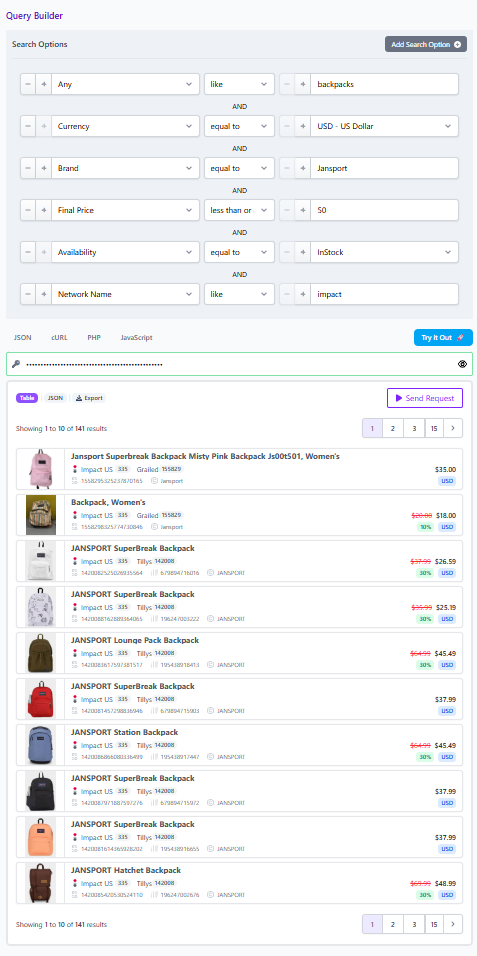
Affiliate.com’s Query Builder supports sharing a link that opens to the query and populates the specified products, streamlining collaboration on curated product lists.
This share link becomes the brief’s receipt:
- Editorial can validate the set visually.
- Partnerships can confirm merchants are acceptable.
- Engineering can mirror the same filters in implementation.
- Support can reproduce issues by opening the same query.
Applied example: an AI brief that becomes a real deals set
An LLM drafts a brief for “in stock outdoor backpacks under 60 dollars, from a short list of brands, with meaningful discounts.”
A production translation:
- Any field search for backpacks in a chosen currency.
- Layer brand filters to narrow to the intended manufacturers.
- Layer final price cap and availability to keep results publishable.
- Layer networks to keep your commissionable results
- For the best performing items, pin identity with barcode and pull alternate merchants for that exact product, then sort by final price or discount depending on the module.
If you publish a deal claim, avoid price guarantees, and recommend readers verify on the merchant page, since prices change.
Make the Query Builder link the center of your AI workflow
If you want AI speed without AI identity errors, treat the LLM as the brief writer and Affiliate.com as the verifier. Start in Query Builder to iterate quickly with the any field and layered filters, pin finalists with barcode, decide deduplication by page intent, then share the query link as the canonical reference for review and implementation.